

NEW 2026 AMERICAN HEART ASSOCIATION GUIDANCE
Heart health nowstarts at 30.
For decades, cardiovascular risk assessment focused largely on middle age. New guidance from the ACC, American Heart Association and nine other medical organizations now recommends estimating both 10- and 30-year risk beginning at age 30.
The reason is simple: cardiovascular disease develops over decades, long before most people feel anything.
NOVOS Science Editorial · 13 min read
What changed
Why medicine is moving cardiovascular prevention earlier
For years, cardiovascular prevention revolved around estimating your chance of a heart attack or stroke over the next 10 years. That creates an obvious problem for a healthy 32-year-old: their 10-year risk is almost always low, even when their lifetime trajectory isn't.
Atherosclerosis doesn't begin at 50. Exposure to blood pressure, atherogenic particles, and metabolic dysfunction accumulates over decades. That is why the 2026 ACC/AHA dyslipidemia guideline now recommends evaluating long-term risk beginning at age 30.[1]
“Treat dyslipidemia earlier to reduce lifelong risk of prolonged exposure to atherogenic lipoproteins.”
2026 Dyslipidemia Guideline
Published March 13, 2026
The world's #1 killer isn't cancer. It's cardiovascular disease.
≈20 million
cardiovascular deaths in 2022, approximately 32% of all global deaths, compared to ~10 million cancer deaths.
World Health Organization.[5]
~1 in 2
U.S. adults already have some form of cardiovascular disease when hypertension is included.
AHA Heart Disease and Stroke Statistics, 2026 Update.[3]
Why it matters beyond the heart
Brain
Blood flow + cognition
Kidneys
Filtration depends on blood flow
Muscle
Oxygen delivery
The good news
Heart disease usually gives you decades to intervene.
The same fact that makes cardiovascular disease dangerous also creates its biggest opportunity: it develops slowly. Arteries stiffen, blood pressure trends upward, and endothelial function declines over years. If you're over 30, the window of greatest leverage is now.
“As much as 80% of heart disease and stroke is preventable with lifestyle changes.”
Individual risk varies
What to do now
Start with what has the strongest evidence.
Move. 150–300 minutes a week of moderate aerobic activity, plus strength training twice a week.[7]
Eat the pattern. Mediterranean-style eating: more vegetables, legumes, fish, and olive oil; less sodium, added sugar, and processed food.[6]
Sleep 7–9 hours. Sleep is one of the AHA's Life's Essential 8.[8]
Don't smoke or vape. Still one of the most powerful modifiable risk factors.[8]
And know your numbers, blood pressure, LDL-C, ApoB, glucose. For some people, lifestyle is enough; for others, a clinician may recommend prescription therapy. The decision belongs with a qualified professional.[1]
A harder category
Which raises an interesting question.
Lifestyle intervention has extensive evidence. Medication has extensive evidence.
But supplements are a difficult category, few test the finished product people actually consume against placebo, on functional biomarkers.
NOVOS Core did.
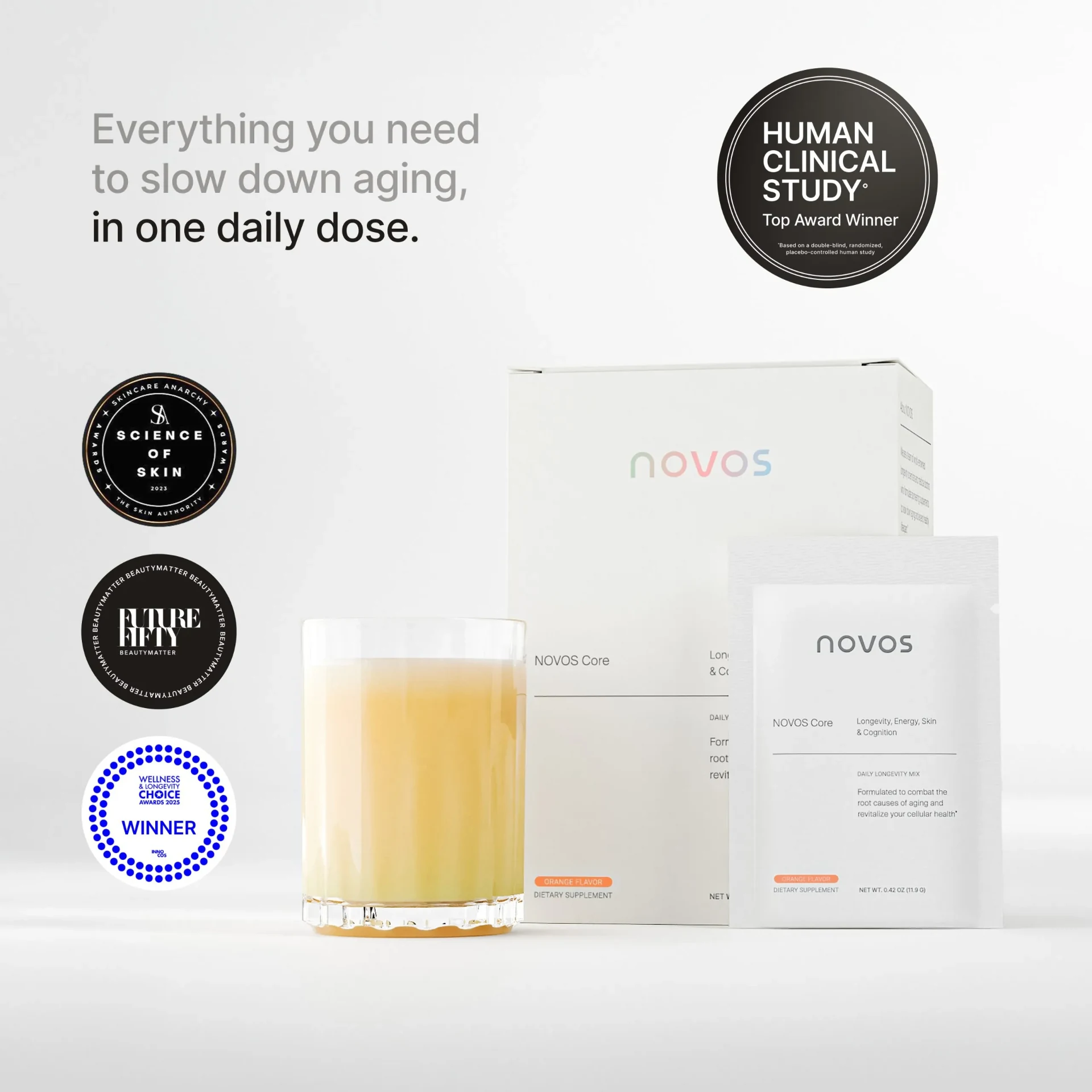
Randomized human research
What happened when NOVOS Core was tested on vascular function?
Researchers at the University of Surrey conducted a randomized, double-blind, placebo-controlled trial of NOVOS Core in generally healthy adults aged 40 and older without established cardiovascular disease.[9]
61
randomized and researchers double blinded
males & females
balanced study design
6 months
daily supplementation or placebo
- Randomized
- Double blind
- Placebo controlled
- University-run
- Pre-registered
- Finished formulation
FMD · endothelial function
+2.9 percentage points
vs placebo at 6 months · pre-specified primary endpoint
Simple interpretation
“How responsive are the vessels?”
- NOVOS Core
- +2.6%
- Placebo
- −0.1%
- Adjusted difference
- +2.9 pp (95% CI 2.1–3.8)
Two more markers
The pattern held across vascular function.
Arterial flexibility (pulse wave velocity) is how easily the large arteries expand and recoil with every heartbeat. As they stiffen with age, the heart has to push harder and pressure waves hit smaller vessels in the brain and kidneys with more force. Pulse wave velocity is the standard measure of that stiffness, and higher values independently predict future cardiovascular events. In the trial it improved by a placebo-adjusted −1.18 m/s at 6 months, a shift in the direction typically associated with younger, more elastic arteries.[9]
Systolic blood pressure is the load the arterial system experiences each time the heart contracts, and it is the single risk factor most tightly linked to stroke and heart failure across a lifetime. Even small, sustained reductions matter at the population level. Here it fell by a placebo-adjusted −6.1 mmHg in participants who began and remained in the normal range, meaning the effect appeared in people who were not hypertensive to begin with.[9]
Notably, these changes occurred without meaningful changes in cholesterol, suggesting the vascular signal was not simply a consequence of lowering lipids.
Flow-mediated dilation · Core vs placebo
Change in FMD from baseline
Adjusted between-group difference at 6 months: +2.9 percentage points (95% CI 2.1–3.8), statistically significant versus placebo.[9]
Study measurement timepoints are not a promise of individual results. Values reflect change from baseline in flow-mediated dilation as reported in the SSRN preprint; manuscript currently under peer review.
Context, not competition
How does the magnitude compare with other interventions studied for the same markers?
These are not head-to-head trials. They are benchmarks from separately published studies and meta-analyses.
Sustained FMD benefit · percentage points
- NOVOS Core2.90
- Resistance training2.11
- Blueberries2.01
- CoQ101.69
- Nitric oxide booster1.60
- Folic acid1.51
- Resveratrol1.40
- Mediterranean diet1.30
- Aerobic exercise1.20
- Cocoa1.20
- Flavonoids1.15
- Severe weight loss1.10
- Walnuts1.05
- Flavan-3-ols1.02
- Omega-31.00
These were separately published studies, not head-to-head comparisons. Study populations, intervention durations, baseline health, measurement methods, and protocols differ. The chart is intended to contextualize the magnitude of reported biomarker changes, not to establish clinical superiority over exercise, diet, or other interventions.
Lifestyle measures such as exercise and heart-healthy diet have broad health benefits that extend far beyond these individual vascular biomarkers and remain foundational cardiovascular recommendations.
“The magnitude and consistency of these effects across multiple cardiovascular endpoints is unusual for a nutritional intervention in a healthy population.”
Professor of Cardiovascular Medicine · University of Surrey
Senior Author
Where NOVOS Core fits
Lifestyle is the foundation. Core is an additional layer.
No supplement replaces exercise, a heart-healthy diet, sleep, not smoking, or appropriate medical care. But for people who already care about cardiovascular longevity, the NOVOS Core trial raises a compelling additional possibility: a daily multi-pathway formula measurably changed how the vascular system functioned, versus placebo, in generally healthy adults.[9]
Clinically studied vascular-aging support
Support the system that supplies every other system.
NOVOS Core is a 12-ingredient longevity formula tested in a randomized, double-blind, placebo-controlled human trial in generally healthy adults 40+, with statistically significant placebo-adjusted differences across endothelial function, arterial flexibility, and healthy systolic blood pressure within the normal range.
This article is for educational purposes only and is not intended to diagnose, treat, cure, or prevent cardiovascular disease or any other medical condition. Individual cardiovascular risk varies. Decisions regarding screening, medication, imaging, and treatment should be made with a qualified healthcare professional. NOVOS Core is a dietary supplement and is not a substitute for prescribed medical therapy.
These statements have not been evaluated by the Food and Drug Administration. This product is not intended to diagnose, treat, cure, or prevent any disease.
Get Started
Learn More About NOVOS Core
See what NOVOS Core is capable of, from cardiovascular health, to skin, cognition, sleep, and more.
Learn about NOVOS COREReferences
[1]American College of Cardiology / American Heart Association and partner societies. 2026 Guideline on the Management of Dyslipidemia. Circulation / Journal of the American College of Cardiology. Published March 13, 2026.
ACC/AHA clinical guidelinesPREVENT-ASCVD in adults ages 30–79, 10- and 30-year risk, Lp(a) at least once in adulthood, selective ApoB, selective CAC (men 40+, women 45+).
[2]AHA / ACC / American Diabetes Association / American Society of Nephrology. 2026 Clinical Guideline for Cardiovascular-Kidney-Metabolic (CKM) Syndrome. Circulation. Published June 2026.
AHA professional guidelinesWhole-body CKM framework: heart, kidney and metabolic health as one interconnected system.
[3]American Heart Association. Heart Disease and Stroke Statistics — 2026 Update. Circulation.
AHA statistical updateU.S. cardiovascular prevalence, hypertension prevalence, CKM risk in young and middle-aged adults, prevention statistics.
[4]Centers for Disease Control and Prevention, National Center for Health Statistics. Mortality in the United States — final 2024 data. NCHS Data Brief.
CDC/NCHS mortality data briefsHeart disease 683,491; cancer 619,876; stroke 166,852; Alzheimer's disease 116,022.
[5]World Health Organization. Cardiovascular diseases and the top 10 causes of death. WHO Fact Sheets.
WHO fact sheets19.8 million cardiovascular deaths in 2022 (~32% of global deaths); cancer and dementia comparisons come from different reporting years.
[6]American Heart Association. Dietary guidance to improve cardiovascular health. Circulation. 2021;144:e472–e487 (with current AHA dietary guidance).
DOI: 10.1161/CIR.0000000000001031Mediterranean-style eating as one heart-healthy dietary pattern.
[7]U.S. Department of Health and Human Services. Physical Activity Guidelines for Americans, 2nd edition. HHS, Washington, DC.
health.gov physical activity guidelines150–300 minutes/week moderate or 75–150 minutes/week vigorous activity, plus muscle strengthening ≥2 days/week.
[8]Lloyd-Jones DM, Allen NB, Anderson CAM, et al. Life's Essential 8: Updating and Enhancing the American Heart Association's Construct of Cardiovascular Health. Circulation. 2022;146(5):e18–e43.
DOI: 10.1161/CIR.0000000000001078Includes healthy sleep (7–9 hours for adults) among the eight cardiovascular health metrics.
[9]Piercy C, Harris J, Sackho K, Campagnolo P, Barardo D, Creagh-Brown B, Heiss C. Acute and 6-Month Vascular Effects of a Multi-Component Nutritional Supplement: A Randomised Controlled Trial. SSRN preprint. February 2026. Manuscript currently under peer review.
SSRN preprintUniversity of Surrey (STAMINA). ClinicalTrials.gov NCT06145087. 61 randomized, 43 completed, 6 months.
[10]Vlachopoulos C, Aznaouridis K, Stefanadis C. Prediction of cardiovascular events and all-cause mortality with arterial stiffness: a systematic review and meta-analysis. Journal of the American College of Cardiology. 2010;55(13):1318–1327.
DOI: 10.1016/j.jacc.2009.10.061Context only: each 1 m/s higher PWV was associated with ~14% higher total cardiovascular-event risk. Not a NOVOS Core risk-reduction claim.
[11]Lewington S, Clarke R, Qizilbash N, Peto R, Collins R (Prospective Studies Collaboration). Age-specific relevance of usual blood pressure to vascular mortality: a meta-analysis of individual data for one million adults. The Lancet. 2002;360(9349):1903–1913.
DOI: 10.1016/S0140-6736(02)11911-8Context only for the population-level relationship between usual systolic blood pressure and vascular mortality.
[12]Medical News Today. “‘Longevity’ supplement improves vascular aging markers in clinical trial.” February 24, 2026.
Medical News TodayIndependent commentary from Professor Christian Heiss and vascular surgeon Christopher Yi, MD. Coverage is not an endorsement of NOVOS.
[13]Thijssen DHJ, Bruno RM, van Mil ACCM, et al. Expert consensus and evidence-based recommendations for the assessment of flow-mediated dilation in humans. European Heart Journal. 2019;40(30):2534–2547.
DOI: 10.1093/eurheartj/ehz350FMD as a non-invasive measure of endothelial function.